How a $300 Weekly Cleaning in Barangaroo Childcare Services Reduced Sick Days for Children
Barangaroo is one of Sydney's newest harbourside neighbourhoods, where thousands of families now live in the apartment towers. Many rely on the small number of long-day childcare and early learning centres that service the precinct.
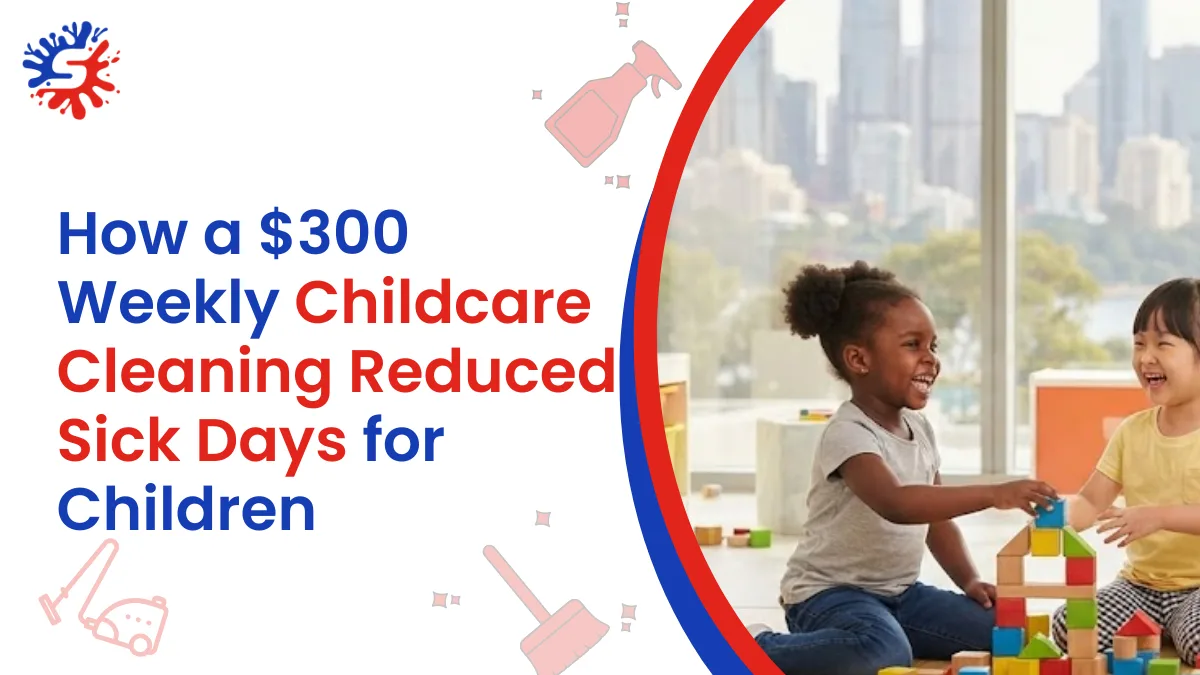
A cough moves through a toddler room within days in childcare. A single case can force a centre to send home a dozen children under exclusion rules. Parents lose paid work, educators fall sick themselves, and the centre's own attendance takes a hit.
Key Takeaways
- Children in daycare settings experience higher rates of gastrointestinal and respiratory infection than children cared for at home, largely due to close contact and shared equipment.
- NHMRC's Staying Healthy guidelines require daily environmental cleaning, immediate cleaning of visibly dirty surfaces, and specific protocols for body fluid spills.
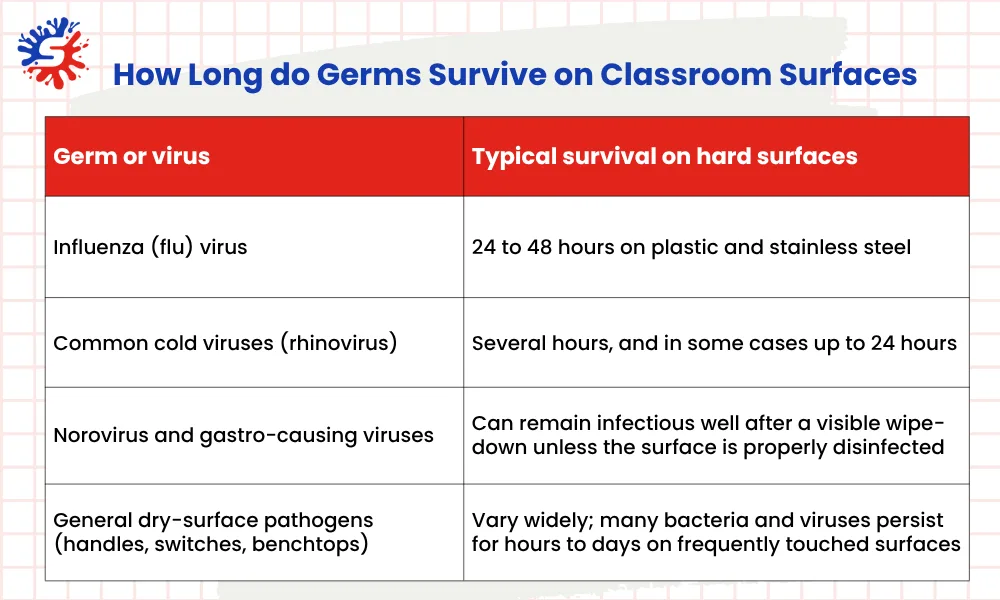
- Flu viruses can survive 24 to 48 hours on hard surfaces such as plastic and stainless steel, making high-touch zones a daily, not weekly, priority.
- A structured $300 weekly clean layered on top of daily educator routines targets high-touch surfaces, toys, soft furnishings, nappy-change areas and kitchens with disinfection-grade methods.
- Families can claim Child Care Subsidy for up to 42 absence days a year; exceeding that allowance because of repeated illness means paying full fees out of pocket.
Why Early Learning Centres are a Perfect Environment for Germs
Young children are hands-on learners by nature. They mouth toys, share cups, wipe their noses on their sleeves, and touch every surface within reach before they have properly learned to wash their hands.
A review of infections in group childcare settings found that children attending daycare consistently experience higher rates of gastrointestinal and respiratory illness than children cared for at home, largely because of close contact, immature immune systems and shared equipment.
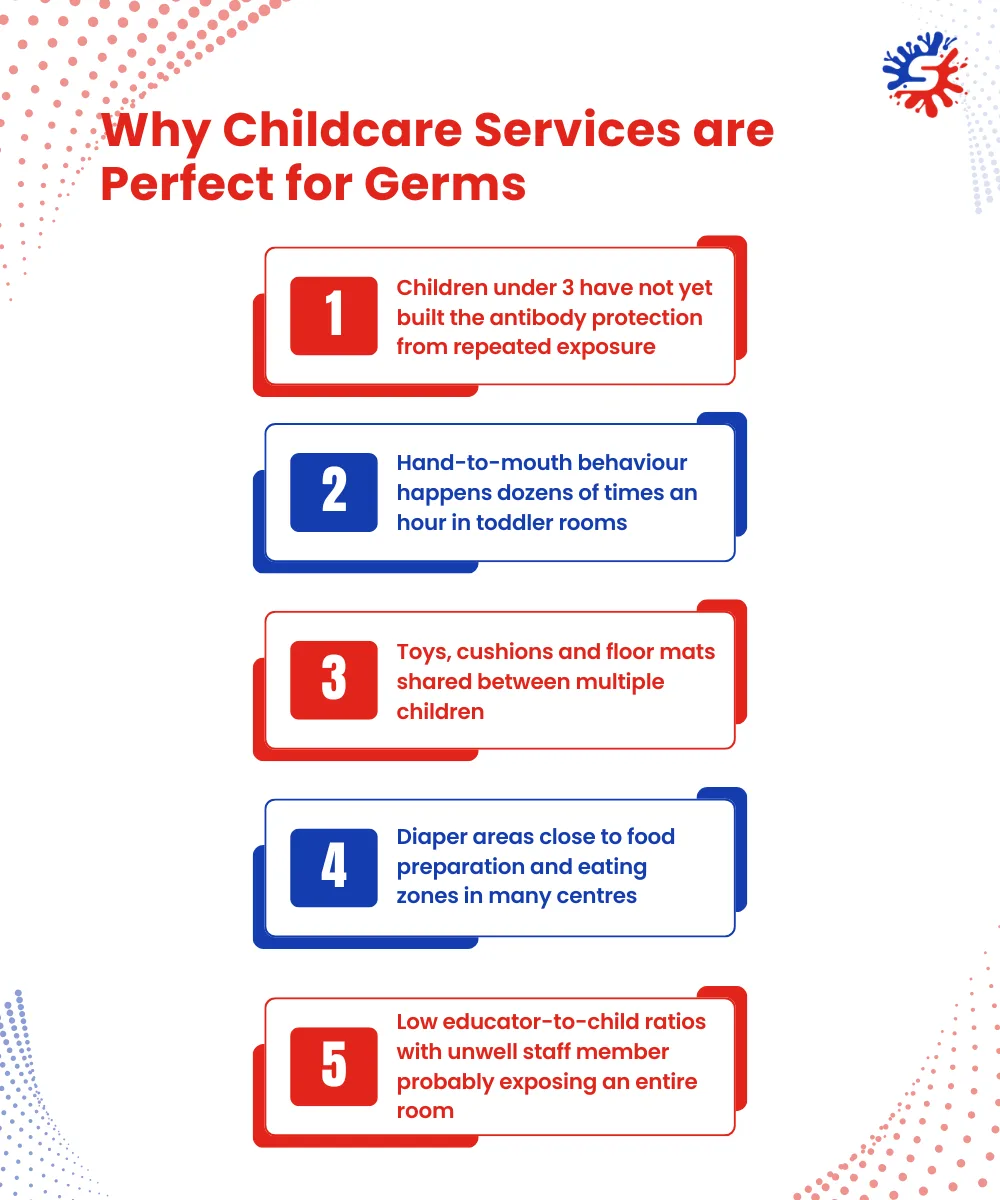
Several factors compound the risk inside an early learning setting:
How Long do Germs Actually Survive on Classroom Surfaces
It helps to understand what a genuinely clean classroom is working against. Different pathogens survive for very different lengths of time once they land on a hard surface, soft toy or piece of furniture.
What the Research Says About Hygiene and Sick Days
The link between hygiene and reduced illness in children is direct. It has been tested in randomised controlled trials.
A cluster-randomised trial across dozens daycare centres, measured hand hygiene compliance and infection rates before and after introducing a structured hand hygiene program for caregivers. The researchers noted that compliance across the sector was low to begin with, hands were adequately washed at fewer than half of the moments guidelines recommend, before the intervention.
Australian data points the same way. Research cited by the Australian Government Department of Health and Aged Care found that the incidence of diarrhoeal episodes among children in childcare centres fell markedly after carers adopted an intensive hand washing program.
Professional cleaning is not a replacement for hand hygiene, but it is the other half of the same equation. Handwashing interrupts transmission between hands and faces. Structured cleaning interrupts transmission between shared surfaces, toys, and hands in the first place, closing a loop that hand hygiene programs alone cannot manage.
Inside a $300 Weekly Clean: What it Actually Covers
A weekly professional clean priced around $300 for a childcare service typically layers on top of, rather than replaces, the daily hygiene routine already carried out by educators. What differs is depth, the use of disinfection rather than just visible cleaning, and consistency.
|
Area |
Weekly task |
Why it matters |
|
High-touch surfaces |
Door handles, light switches, tap handles and gate latches disinfected, not just wiped |
Named specifically in NHMRC guidance as priority transmission points |
|
Toys and shared equipment |
Rotated through a wash-and-dry or wipe-down cycle |
Hand-to-mouth contact makes toys among the highest-risk items in a toddler room |
|
Soft furnishings, mats and rugs |
Vacuumed weekly, periodically extracted |
Porous surfaces hold germs and allergens longer than hard flooring |
|
Nappy-change and toileting areas |
Deep sanitised, fixtures descaled |
NHMRC specifically requires infection control principles here |
|
Kitchen and food-prep zones |
Degreased and sanitised, including range hoods and splashbacks |
Cross-contamination risk overlaps with food hygiene concerns |
|
Bathrooms and handwashing stations |
Descaled, tap handles disinfected, soap dispensers checked and refilled |
Directly tied to the handwashing compliance research above |
|
Floors |
Mopped with a hospital-grade disinfectant, not just detergent |
Detergent lifts visible dirt but does not necessarily kill pathogens |
Soft furnishings and rugs deserve particular attention. We have covered why in more detail in our carpet hygiene stats piece, and centres running mats and rugs through a periodic extraction, rather than a vacuum alone. The same logic applies to food-prep areas, which we cover in Kitchen Hygiene Statistics, and to nappy-change and toilet zones, covered in bathroom hygiene statistics.
What Barangaroo Centres Can Expect to See
Centres in a dense, harbourside precinct like Barangaroo face a specific version of this problem. Most operate inside multi-storey commercial buildings with shared lift lobbies, limited outdoor space, and little room to isolate an unwell child away from the rest of the group while a parent is contacted. A shared lift button or lobby door handle becomes an extra transmission point that a suburban, standalone centre simply does not have to manage.
Families in the surrounding towers are also, disproportionately, dual-income professional households, any childcare disruption converts directly into missed work for both parents rather than one parent absorbing the gap. Centres that introduce a structured weekly clean, alongside the daily routines their educators already run, typically report the same pattern the research above describes.
Educator Illness Has a Cost Too
Hygiene investment protects staff as much as it protects enrolled children. Ratio requirements mean a centre cannot simply run short-staffed when an educator calls in sick, and casual cover is neither cheap nor always available at short notice. Educators who spend all day around toddlers, touching their faces, are themselves in one of the higher-exposure roles in any workplace, and the same transmission chains that put children at risk work in reverse as well.
Sydney workplaces more broadly have been increasing hygiene budgets for exactly this reason, something we explored in why sydney offices are investing over $20B in hygiene standards. A childcare centre is simply an intensified version of that same workplace hygiene equation, with less capacity for staff to work from home while unwell and higher stakes if an infection spreads.
The Real Cost of a Sick Day, for Families and for Centres
Illness in childcare is not just an inconvenience. It carries a measurable financial cost on both sides of the enrolment.
For families, the Australian Government's Child Care Subsidy allows for 42 absence days a year per child, covering a mix of sick days, family days and holidays, after which subsidy support for further absences typically stops.
Families who exceed that allowance, often because of repeated illness in a high-transmission environment, face the full daily fee out of pocket. The Australian Bureau of Statistics has reported that child-care responsibilities account for 24% of unavailability, keeping parents out of work hours.
Building a Weekly Cleaning Program That Actually Works
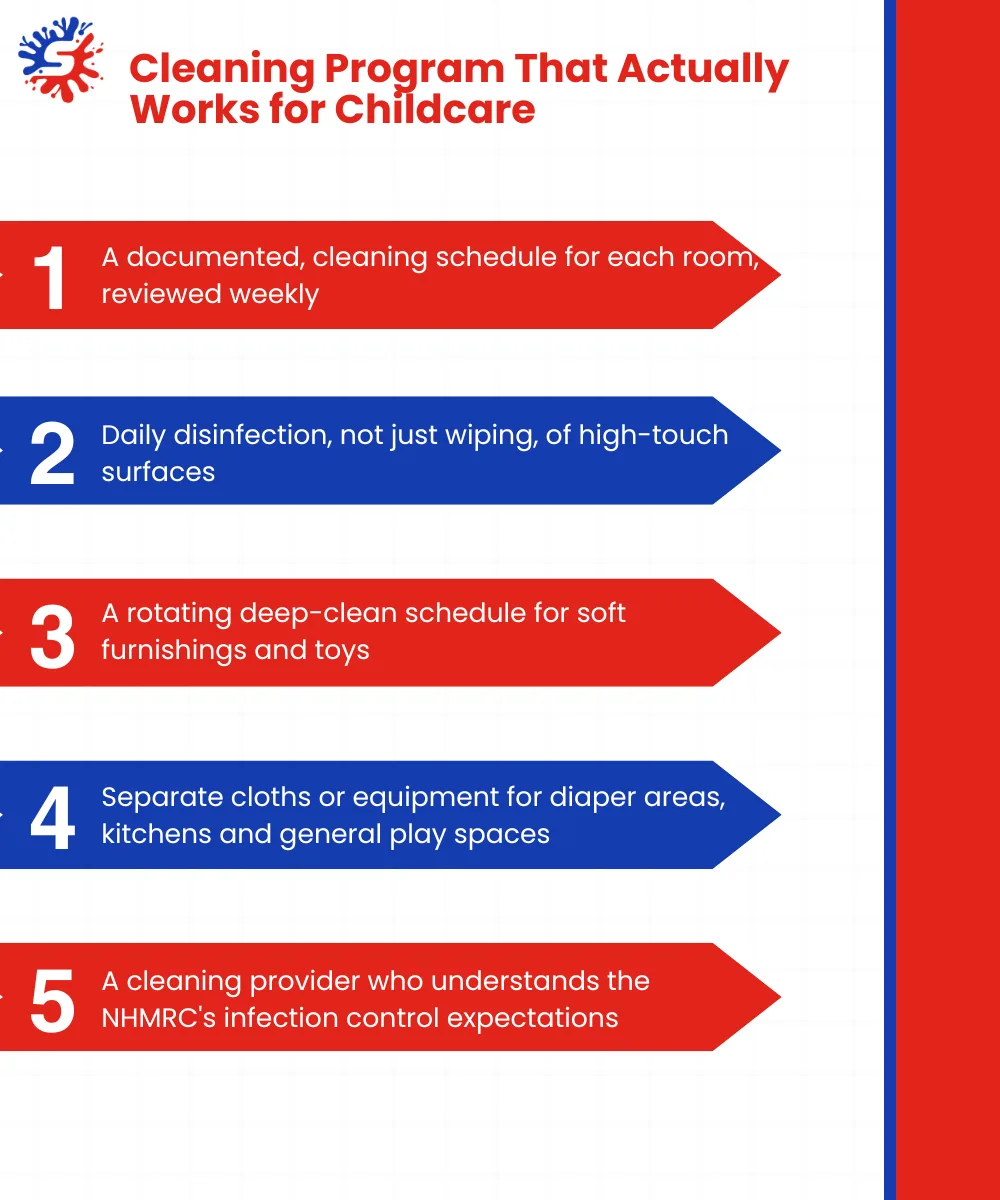
Not every cleaning schedule delivers the same result. Based on NHMRC guidance and the research above, an effective weekly program for an early learning centre generally includes:
Choosing the Right Cleaning Partner for an Early Learning Service
For a Barangaroo centre serving families, a $300 weekly investment in professional cleaning is a modest price against the alternative. Centres that treat cleaning as part of their health strategy are the ones most likely to keep their rooms full and their exclusion registers short.
Ready to build a hygiene program that matches what regulators, and parents, expect from a Barangaroo early learning service? Book a free consultation today to scope a weekly cleaning plan built around your childcare centre's rooms requirements.
Frequently Asked Questions
Find quick answers to booking, payments, pet-friendly policies, deep cleaning, and more. Our team is dedicated to making the process effortless and transparent. If you have additional questions, we're here to help ensure a seamless experience.
Get In Touch