How Specialized Dusting Saved a Northern Sydney Tech Hub $10,000 Annually
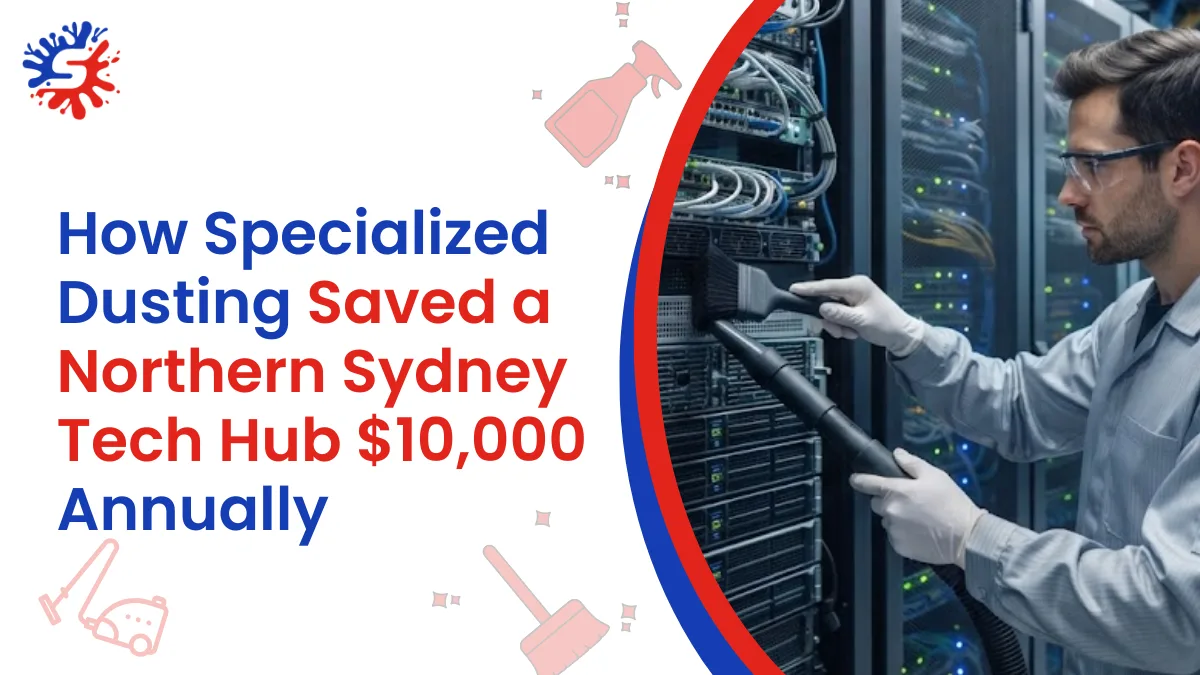
When a fast-growing software company in Northern Sydney signed off on a specialised, dust-focused cleaning contract, nobody in the finance team expected it to show up on the annual budget review. But it did: roughly $10,000 in avoided costs across energy bills, IT hardware, and lost productivity within 12 months.
Most facilities budgets treat cleaning as a fixed, unavoidable line item, something you pay for hygiene and appearance, full stop. What rarely gets modelled is the flip side: how much a lack of thorough, targeted cleaning quietly costs elsewhere in the business, through HVAC strain, hardware wear, IT callouts, and staff comfort.
Key Takeaways
- A Northern Sydney tech hub saved an estimated $10,000 a year after adding specialised dusting to its cleaning program.
- Clean HVAC filters and coils can cut cooling energy use by 5–15% (DOE), and up to 45.5% in fouled-filter/leaky-duct scenarios
- Dust contributes to roughly 8% of electronic device failures, compounding heat-related component wear
- People spend about 90% of their time indoors, where particulate levels are higher than outdoors, directly affecting comfort and sick days
- Because HVAC drives roughly 40% of a typical building's energy use, keeping it dust-free also helps protect NABERS ratings and supports WHS obligations around indoor air quality
The Cost of Dust in a Modern Tech Workspace
In a technology office, dust is a fine mix of skin cells, fabric fibres, outdoor particulates, and toner residue that settles on every surface, including the ones that keep your building and equipment running. People spend about 90% of their time indoors, where pollutant concentrations. It works its way into three cost centres at once:
-
Energy bills: Dust-clogged HVAC filters and coils force cooling systems to run longer and harder.
-
Hardware: Dust insulates heat sinks and clogs fans inside servers, PCs, and network cabinets.
-
People: Indoor particulates are recognised asthma and allergy triggers that contribute to sick days and reduced focus.
Why Tech-Heavy Offices Are More Vulnerable Than Standard Workspaces
A typical accounting or legal office loses some efficiency to dust. A tech hub loses more, because it runs more heat-generating equipment per square metre: servers, comms rooms, multiple monitors, and always-on desktops.
More equipment means more fans pulling in air (and dust), and more components that are sensitive to heat. This is the same logic behind why we recommend a tighter cleaning cadence for commercial and office environments with dense IT infrastructure compared to a standard retail fit-out.
Sydney's Climate Adds to the Dust Load
Northern Sydney's warm, humid climate is part of the problem. Longer cooling seasons mean HVAC systems run more hours per year than in cooler capitals, giving dust more opportunities to accumulate on filters, coils, and vents before a scheduled service.
Humidity also matters beyond comfort: the EPA notes that relative humidity levels above the recommended 30–50% range can help dust mites and mould thrive. This is one reason a generic, once-a-week wipe-down cleaning schedule, copied from a cooler-climate template, tends to fall short for local offices.
Case Study: A Northern Sydney Tech Hub's $10,000 Turnaround
The business in question is a 68-person software and product team occupying a mid-rise office in the Norwest/Macquarie Park corridor of Northern Sydney, a growing hub for data, SaaS, and engineering firms. Their office ran two comms rooms, roughly 90 workstations, and a rooftop-mounted split HVAC system. Before working with a specialised cleaning provider, their setup looked like this:
-
Dusting was limited to visible desk surfaces during a weekly general clean.
-
HVAC filters and vents were serviced only during the building's mechanical contractor's annual inspection.
-
Server room cabinets and rear vent panels had not been opened or cleaned in over 18 months.
-
IT reported at least one heat-related hardware fault (fan failure, thermal shutdown, or throttling) every 4 to 6 weeks.
After switching to a specialised dusting and hygiene program, similar in scope to our office cleaning service, the business tracked the following changes over the following 12 months:
|
Metric |
Before Specialised Dusting |
After 12 Months |
|
HVAC electricity spend (cooling season) |
Baseline |
Down ~12% |
|
Heat-related IT hardware faults |
~1 every 4–6 weeks |
~1 every 5–6 months |
|
Callout / emergency IT technician visits |
9 per year |
2 per year |
|
Reported allergy/eye-irritation complaints |
Recurring, monthly |
Rare |
|
Estimated annual saving |
— |
~$10,000 |
Figures reflect the client's internal facilities and IT tracking, aggregated across energy, maintenance, and callout invoices; individual results vary by building age, equipment density, and HVAC system.
Where the $10,000 in Savings Actually Came From
The number breaks down into five overlapping cost categories. None of them is dramatic on its own; together, they add up quickly.
1. Lower HVAC and Cooling Energy Bills
This is the largest and best-documented category. Replacing a dirty air filter with a clean one can cut a cooling system's energy consumption by 5% to 15%. A separate laboratory study reviewed by ScienceDirect found that fouled filters, combined with duct leakage, can increase HVAC fan energy consumption by up to 45.5%.
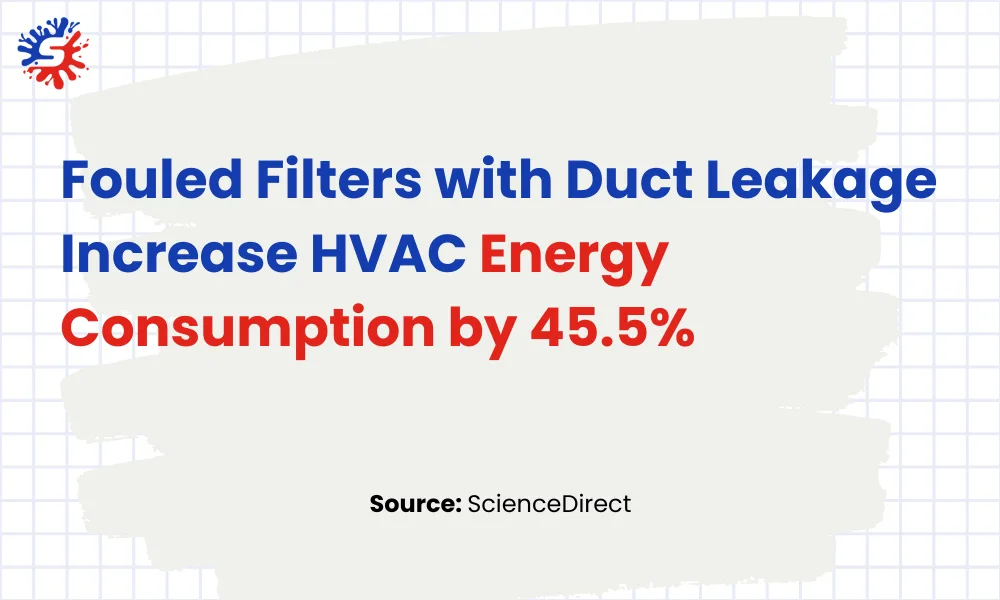
These percentages matter more than they might first appear, because HVAC is not a minor line item. The Australian Government's HVAC factsheet states that a typical office building's HVAC system accounts for approximately 40% of total building energy consumption and 70% of base building energy consumption.
2. Fewer Hardware Failures and IT Callouts
Peer-reviewed engineering research published states that 8% of electrical/electronic device failures are directly attributable to dust, alongside temperature (55%), vibration (45%), and humidity (19%) as contributing factors; dust often works alongside heat since it insulates components and blocks fans. Fewer dust-clogged fans and vents mean fewer thermal shutdowns, fewer emergency IT technician visits, and longer intervals between hardware replacements.
3. Extended Equipment Lifespan
Every avoided thermal fault also avoids a chain reaction: a technician callout, potential data loss or downtime, and, eventually, early replacement of a server, switch, or workstation. Stretching replacement cycles by even a year on a handful of devices adds up to real capital savings, on top of the direct maintenance costs above.
4. Reduced Sick Days and Better Focus
Biological contaminants such as dust mite allergens, pet dander, and accumulated particulates are significant triggers for allergic reactions and can exacerbate asthma, which impacts over 2.8 million Australians. Regular, thorough cleaning is essential to reduce the reservoir of allergens. By removing these particles at the source, you prevent them from being recirculated through the office air every time the HVAC system cycles, leading to a healthier workplace and fewer staff absences.
5. Avoided Emergency Deep-Cleans and Surface Damage
Neglected dust doesn't stay put. It settles into carpet fibres, grinds into flooring underfoot, and builds up in corners until an emergency deep-clean is the only fix. We've seen this play out specifically with flooring. Our related case study on Darlinghurst flooring repairs, shows the same principle at work: small, regular maintenance spend heads off large, reactive repair bills.
The Bigger Picture: Workplace Cleanliness and Australian Productivity
Dust and hygiene aren't just a facilities issue; they sit inside a much larger conversation about workplace conditions and productivity that Australian regulators take seriously. Safe Work Australia research has quantified the cost of poor workplace conditions to employers in absenteeism and presenteeism, which amounts to 6 billion dollars a year.
None of this means that a cleaning contract alone will solve workplace productivity issues. But it does mean office hygiene is one of the more controllable, lower-cost levers available to a facilities or operations manager, compared to the larger structural drivers of workplace wellbeing. A clean, well-maintained, dust-free environment removes one variable from the equation rather than adding to it.
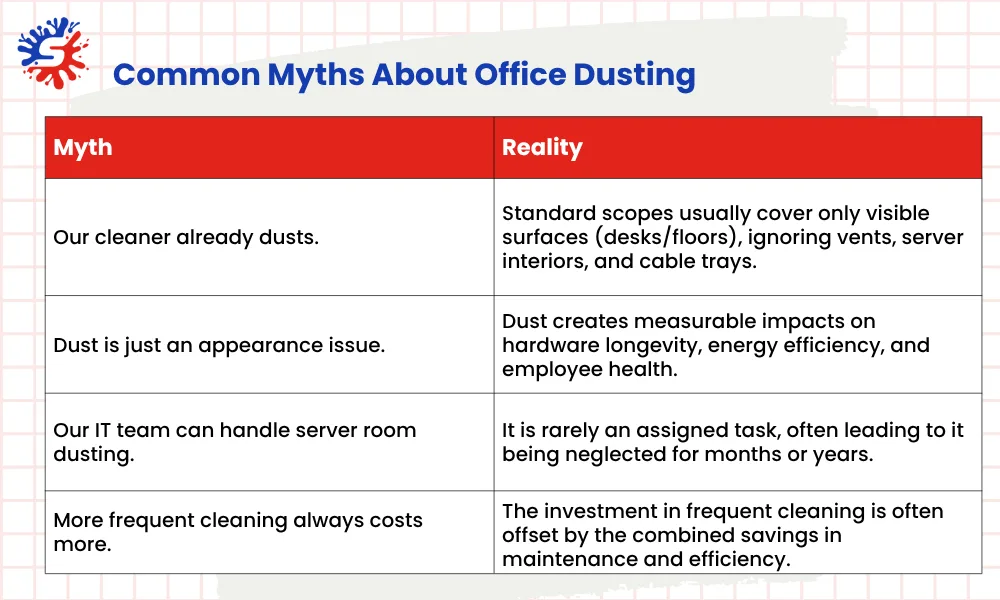
Common Myths About Office Dusting
A few misconceptions keep businesses from budgeting properly for this. Worth clearing up:
Compliance, WHS, and NABERS: Why This Matters Beyond the Balance Sheet
There's also a compliance angle. Under Australian work health and safety (WHS) laws, employers have a general duty to provide a working environment that doesn't create foreseeable health risks, which extends to indoor air quality and allergen control.
Separately, commercial landlords increasingly track NABERS energy ratings, and since HVAC performance accounts for a large share of a building's energy footprint, keeping filters, coils, and vents free of dust buildup helps a tenancy or base building maintain its rating rather than quietly drift down over time.
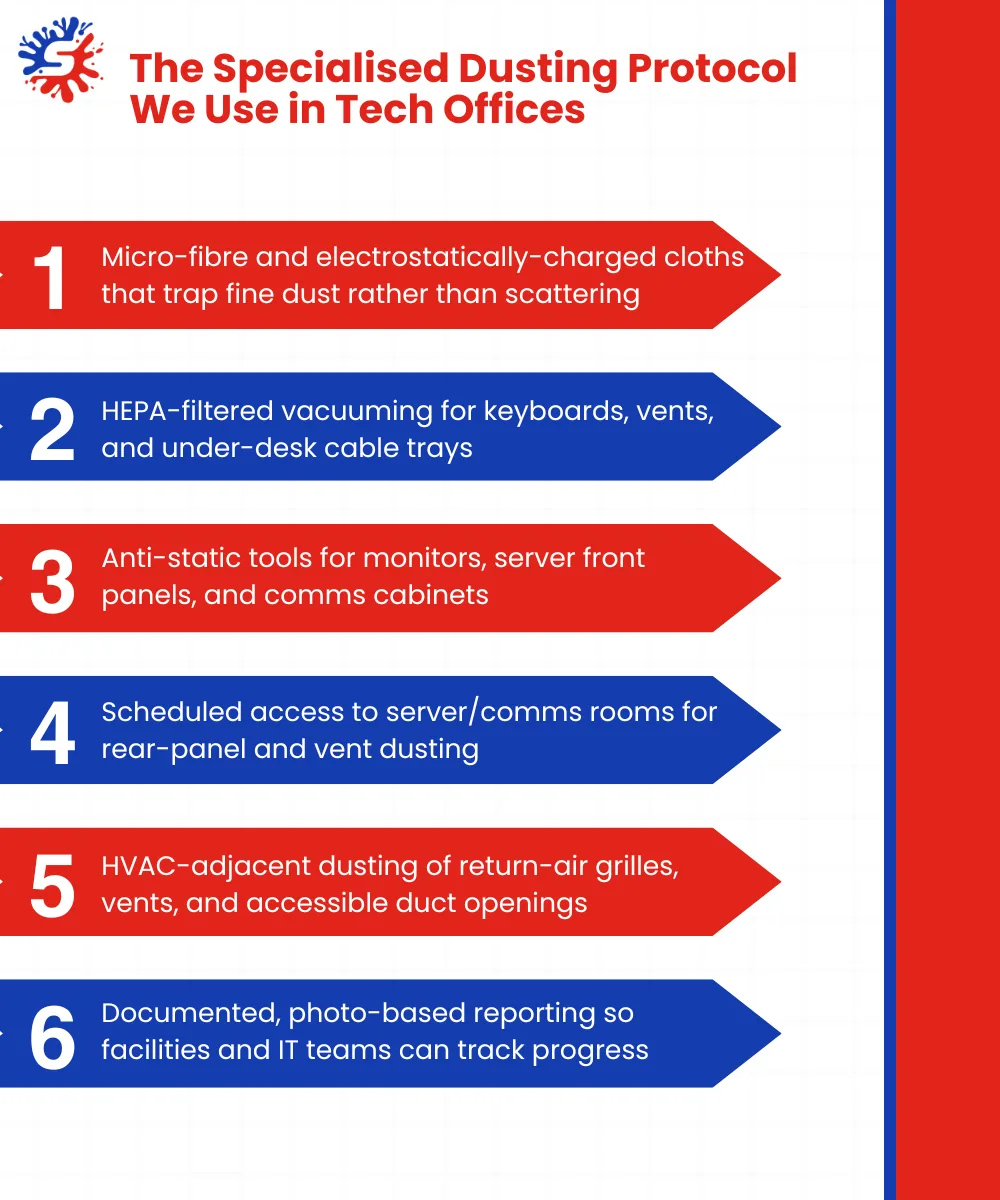
The Specialised Dusting Protocol We Use in Tech Offices
A standard office clean typically covers desks, floors, and bathrooms. A specialised dusting protocol for IT-heavy environments goes further, targeting the surfaces and equipment that standard cleans routinely miss:
A Sample Cleaning Frequency Schedule
| Frequency | Tasks |
|---|---|
| Daily | Desks, keyboards, high-touch surfaces, bins |
| Weekly | Monitors, phones, shared equipment, skirting boards |
| Monthly | Return-air vents/grilles, under-desk cable trays, blinds |
| Quarterly | Server room rear panels, comms cabinets, ceiling vents |
| Bi-Annually | Deep vacuum of carpets and upholstery to remove embedded dust |
This is broadly consistent with the direction Sydney commercial buildings are already heading. Our earlier article, on Sydney Offices hygiene standards, covers how hygiene spend across the commercial sector is being treated less as overhead and more as risk management.
Does This Apply Beyond Northern Sydney Tech Offices?
Yes, while this case study centres on a Macquarie Park-area tech company, the same mechanics apply to any commercial office with meaningful IT infrastructure, from CBD fintech floors to co-working spaces in Chatswood or St Leonards.
Buildings with heavy foot traffic and carpet, such as those covered in our carpet hygiene research, or long-term tenancies aiming to protect their fit-out, see comparable payback from the same disciplined approach.
How to Estimate Your Own Office's Dust-Related Losses
You don't need a facilities engineering degree to get a rough number for your own office. Work through these steps:
-
Pull your last 12 months of HVAC/cooling energy bills and flag any unexplained upward trend.
-
Ask IT for a count of heat-related hardware faults or callouts during the same period (e.g., fan failures, thermal shutdowns, throttling complaints).
-
Check whether your comms room or server cabinet vents have been opened and cleaned in the last 6 months.
-
Estimate the average cost of a single IT callout or emergency repair, then multiply by the fault count above.
-
Add a conservative allowance (5–15%, per DOE guidance) for HVAC energy waste from dust and filter neglect.
-
Compare the total to the cost of a specialised dusting add-on to your existing cleaning contract, most Sydney offices find the maintenance cost is a fraction of the losses it prevents.
Conclusion
The outdated view that office cleaning is merely a fixed overhead cost is a missed opportunity for tech-heavy businesses. By shifting to a specialized, dust-focused cleaning protocol, you move from reactive maintenance to proactive asset management. This transition does more than improve aesthetics; it significantly reduces energy waste from HVAC systems, prevents costly IT hardware failures, and fosters a healthier, more productive workspace.
At Spark Clean Australia, we provide the specialized equipment and technical expertise necessary to protect your infrastructure. By treating office hygiene as a strategic lever for efficiency rather than just a janitorial task, you can turn your cleaning budget into a driver of operational savings. Contact us today for a workspace audit and discover how a disciplined approach to dusting can safeguard your assets and your bottom line.
Frequently Asked Questions
Find quick answers to booking, payments, pet-friendly policies, deep cleaning, and more. Our team is dedicated to making the process effortless and transparent. If you have additional questions, we're here to help ensure a seamless experience.
Get In Touch