
How Spending $500 on Cleaning Saves You $20,000 in Darlinghurst Flooring Repairs
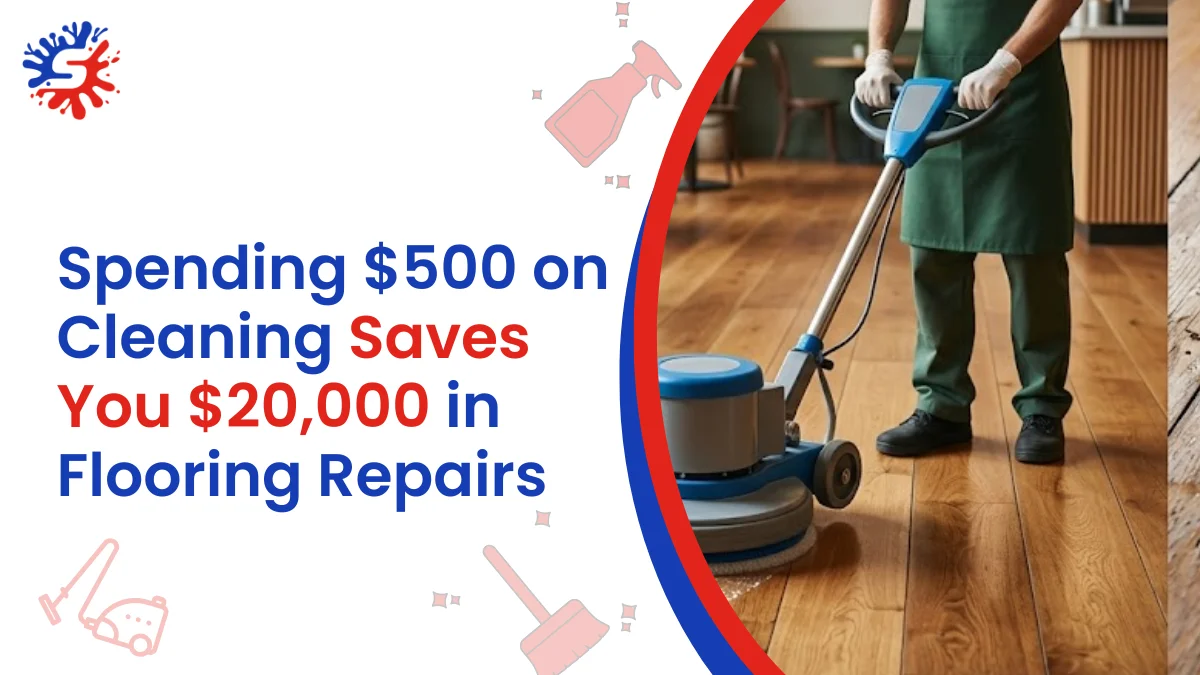
Darlinghurst sits at the intersection of old Sydney and new money. Whether heritage or modern, they share one thing: their floors take a battering from foot traffic, humidity, and the daily accumulation of grit, moisture, and chemicals.
The financial consequence is predictable. Flooring across all material categories degrades far faster with inadequate maintenance. Restoration and replacement costs in Sydney run from $25 per square metre for tile regrouting to $200 per square metre for marble restoration.
For a 150–200m² Darlinghurst commercial space, a single premature replacement or restoration job can erase years of perceived savings from skipping professional cleaning.
Key Takeaways
-
Every commercial flooring material type in Darlinghurst degrades significantly faster without structured professional maintenance
-
Marble and natural stone floors face irreversible acid-etching damage from incorrect cleaning chemistry
-
Grout in commercial tile floors begins degrading from the first week of use without scheduled professional deep cleaning.
-
Timber floors require controlled-moisture professional cleaning. Wet mopping causes structural moisture damage leading to board warping and expensive restoration.
-
Vinyl plank and LVT floors cannot be repaired when the wear layer is scratched through. Regular professional cleaning that removes abrasive grit before it reaches the wear layer is the only way to defer this replacement cost
-
A structured commercial cleaning programme for a 150–200m² mixed-floor Darlinghurst premises at approximately $500 per month saves an estimated $10,000–$31,000 in flooring repair and replacement costs over a 10-year period
Commercial Flooring: Your Most Expensive Neglected Business Asset
Most Darlinghurst business operators do not consider flooring a managed asset. It is treated as a fixed feature, installed once, cleaned when dirt becomes visible, and replaced when it looks genuinely terrible. This reactive approach costs significantly more than a proactive maintenance model.
Every commercial flooring material has a protective layer or structural integrity that can be maintained or degraded. Cleaning removes the contaminants that attack those properties. Skipping cleaning allows contaminants to accumulate, causing progressive, cumulative damage that cannot be cheaply reversed.
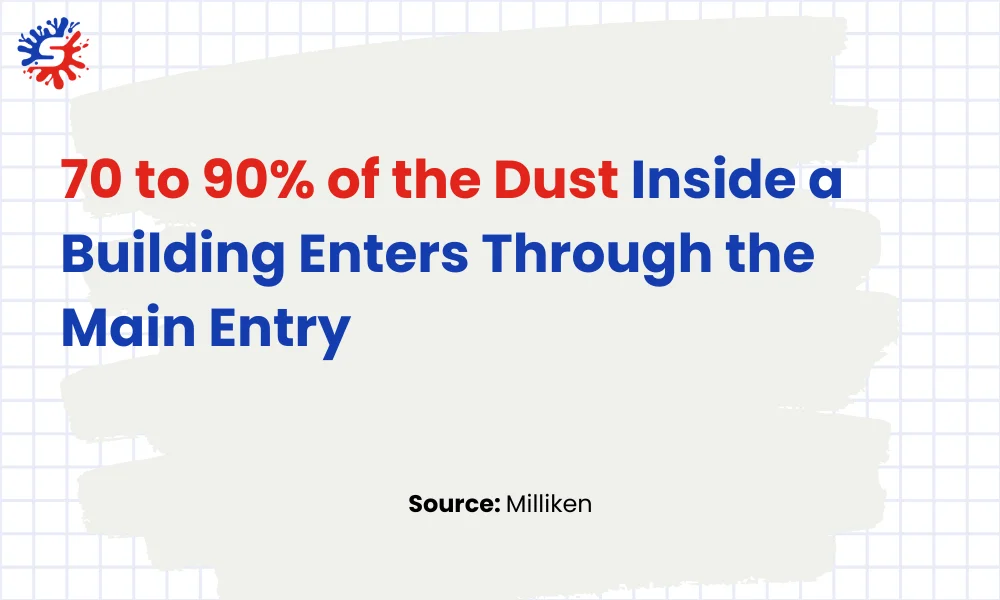
70 to 90% of dust and soil inside a building enters through entry points as dry particulate matter. Without structured entry zone cleaning and regular floor maintenance, that grit is being ground into every surface type on site, every day.
For the broader case on why workplace cleanliness connects to business costs, see our post on why Sydney CBD offices partner with professional cleaning companies.
How Cleaning Neglect Damages Each Floor Type
Different materials fail in different ways. Understanding the damage pathway for your specific flooring is the clearest way to quantify the risk of under-maintenance.
Ceramic and Porcelain Tile Floors
Tile is one of the most common commercial floor surfaces in Darlinghurst, found in reception areas, kitchens, bathrooms, retail floors, and medical practices throughout the suburb. Its reputation for durability is partly earned, but entirely conditional on grout maintenance.
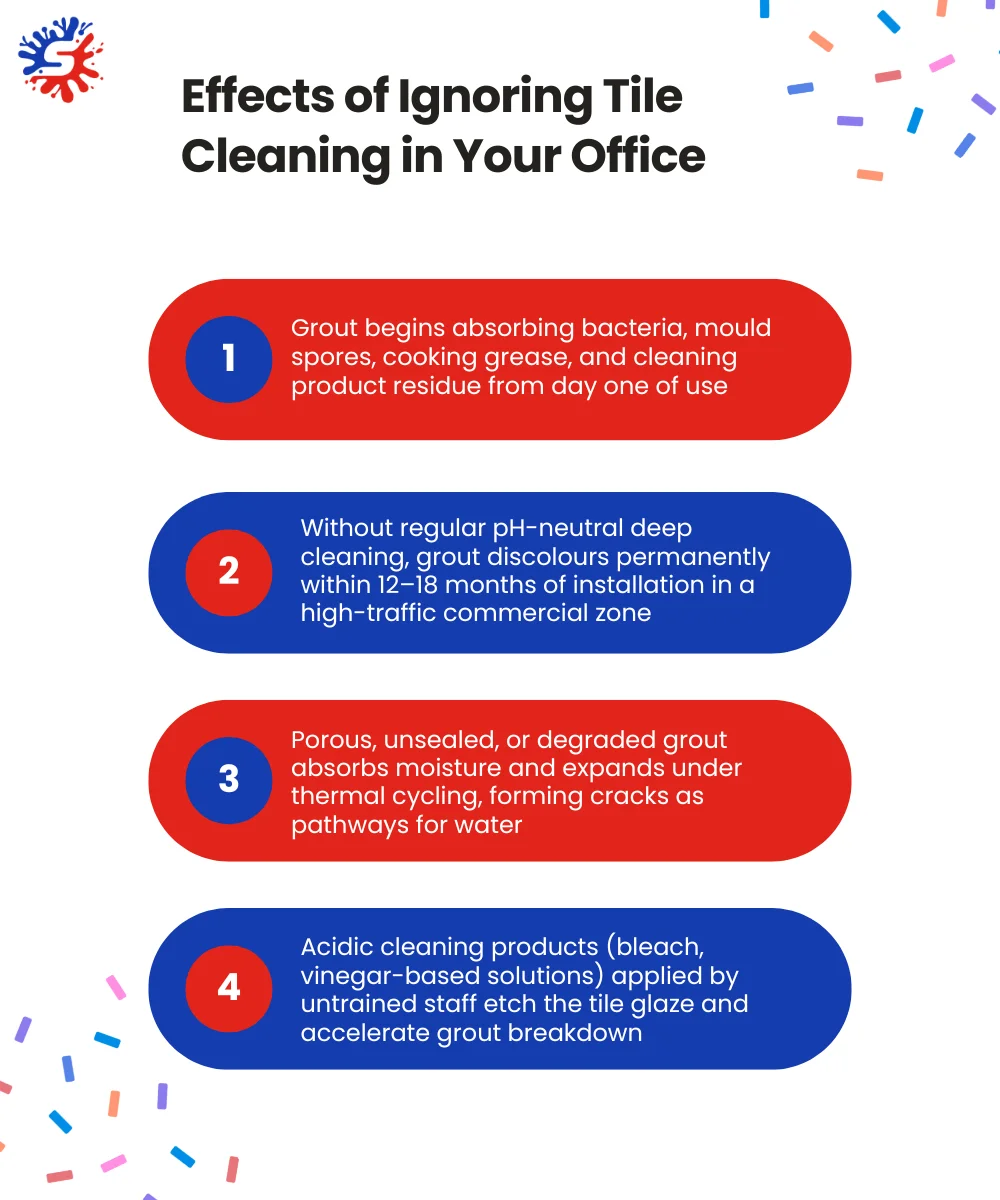
The tile itself is highly durable. Whereas grout is porous, absorbent, and reactive to moisture, acid, and cleaning chemicals. In a high-traffic commercial setting without consistent professional maintenance:
Marble, Travertine, and Natural Stone Floors
Marble is common in Darlinghurst office lobbies, legal practices, healthcare reception areas, and heritage-converted premises throughout the suburb. It is also the flooring material most sensitive to improper cleaning and the one for which maintenance failures carry the highest restoration costs.
The core vulnerability of marble and other calcite-based stones (limestone, travertine) is acid sensitivity. Marble is composed largely of calcium carbonate, which reacts with acidic substances, causing surface etching. Etching permanently dullens the stone surface and cannot be removed by cleaning alone.
Hardwood and Engineered Timber Floors
Timber floors are found throughout Darlinghurst's heritage commercial stock. Timber is visually striking and adds significant perceived value to commercial spaces. It is also highly sensitive to moisture, abrasive grit, and incorrect cleaning chemistry.
How cleaning neglect damages timber flooring:
|
Neglect Factor |
Mechanism of Damage |
What Happens |
|
Dry grit tracked from outside |
Acts as sandpaper underfoot |
Micro-scratches in finish build up; finish fails; bare timber exposed |
|
Moisture mopping (over-wet cleaning) |
Water absorbed into wood grain |
Warping, cupping, swelling of boards; permanent deformation |
|
Incorrect cleaning chemistry |
Alkaline or solvent-based cleaners strip finish |
Finish peels, bare timber exposed, staining risk multiplied |
|
Lack of entry matting |
Maximum grit load delivered to the floor surface |
Accelerated finish wear; boards require sanding in 3–5 years, not 10–15 |
Polished Concrete Floors
Polished concrete is the signature floor of contemporary Darlinghurst retail, hospitality, and creative office spaces. It is genuinely durable, but that durability depends entirely on maintaining the sealant layer applied during installation.
Without that sealant layer intact:
-
Polished concrete becomes porous and begins absorbing stains, oils, and moisture from the first contact
-
Water ingress into unsealed concrete causes efflorescence, white mineral deposits that are difficult to remove and signal structural moisture penetration
-
Spilled oils and chemicals penetrate the slab and can cause permanent discolouration that cleaning cannot lift
-
Foot traffic grit micro-scratches the polished surface, progressively dulling the finish that defined the floor's appearance
Vinyl Plank and Luxury Vinyl Tile (LVT)
Vinyl plank and LVT have become the dominant flooring choice in new Darlinghurst commercial fit-outs due to their water resistance, durability, and design flexibility. They are also the most forgiving floor type, but only if maintained correctly. Critically, 'water resistant' does not mean maintenance-free.
The failure mode of vinyl in commercial settings is wear-layer degradation. Vinyl flooring has a protective wear layer measured in millimetres. Once that layer is scratched through by abrasive grit, the floor cannot be repaired. Unlike timber, vinyl cannot be sanded and refinished.
The $500 vs $20,000 Comparison: How the Numbers Stack Up
To make this comparison concrete, consider a typical 150m² Darlinghurst commercial premises: a mix of floor types, large-format tile in the main area, timber in a feature room or reception, vinyl in the kitchen and amenities, and a marble element in the lobby entry.
The Monthly Cleaning Investment
|
Cleaning Service |
Frequency |
Estimated Monthly Cost |
|
Weekly office clean incl. floor sweep, mop, surface maintenance |
4x per month |
$280–$400 |
|
Hard floor machine scrub (tile, vinyl, concrete zones) |
Monthly |
$80–$120 amortised |
|
Tile and grout deep clean + reseal |
Bi-annual |
$40–$70 amortised monthly |
|
Timber floor damp mop with pH-neutral product |
Weekly, included in office clean |
Included above |
|
Marble maintenance clean with stone-safe chemistry |
Monthly, included in schedule |
Included above |
|
Total monthly cleaning programme |
$400–$590 / month |
Using $500 per month as a representative midpoint: annualised, this cleaning programme costs $6,000 per year.
The Cost of Skipping it
|
Floor Type (in 150m² mixed premises) |
Area |
Premature Repair/Replace Without Cleaning |
With Cleaning (Scheduled Maintenance) |
|
Tile (grout failure, retile at year 8 not 20) |
60m² |
$3,600–$12,000 (regrouting to retiling) |
$1,500 in periodic resealing over 10 years |
|
Marble lobby (etch + staining, restoration at year 3–4) |
20m² |
$2,400–$7,500 per restoration cycle |
$300–$600 per maintenance sealing cycle |
|
Timber (finish failure, full sand at year 4 not year 12) |
40m² |
$2,000–$3,000 (sanding + refinish) |
$0, maintenance cleaning sustains finish |
|
Vinyl (wear layer failure, replacement at year 5 not year 12) |
30m² |
$1,650–$3,900 (full replacement) |
$0, sustained by proper cleaning protocol |
What Professional Commercial Floor Cleaning Actually Involves
There is a significant gap between what is commonly called 'commercial cleaning' and what constitutes genuine floor asset maintenance. Understanding the difference is key to achieving the financial outcome the numbers above describe.
Surface Cleaning vs. Asset Maintenance Cleaning
Applying the wrong chemistry to marble causes permanent damage that professional cleaning could have prevented. Wet mopping timber accelerates moisture damage, leading to board warping and costly restoration.
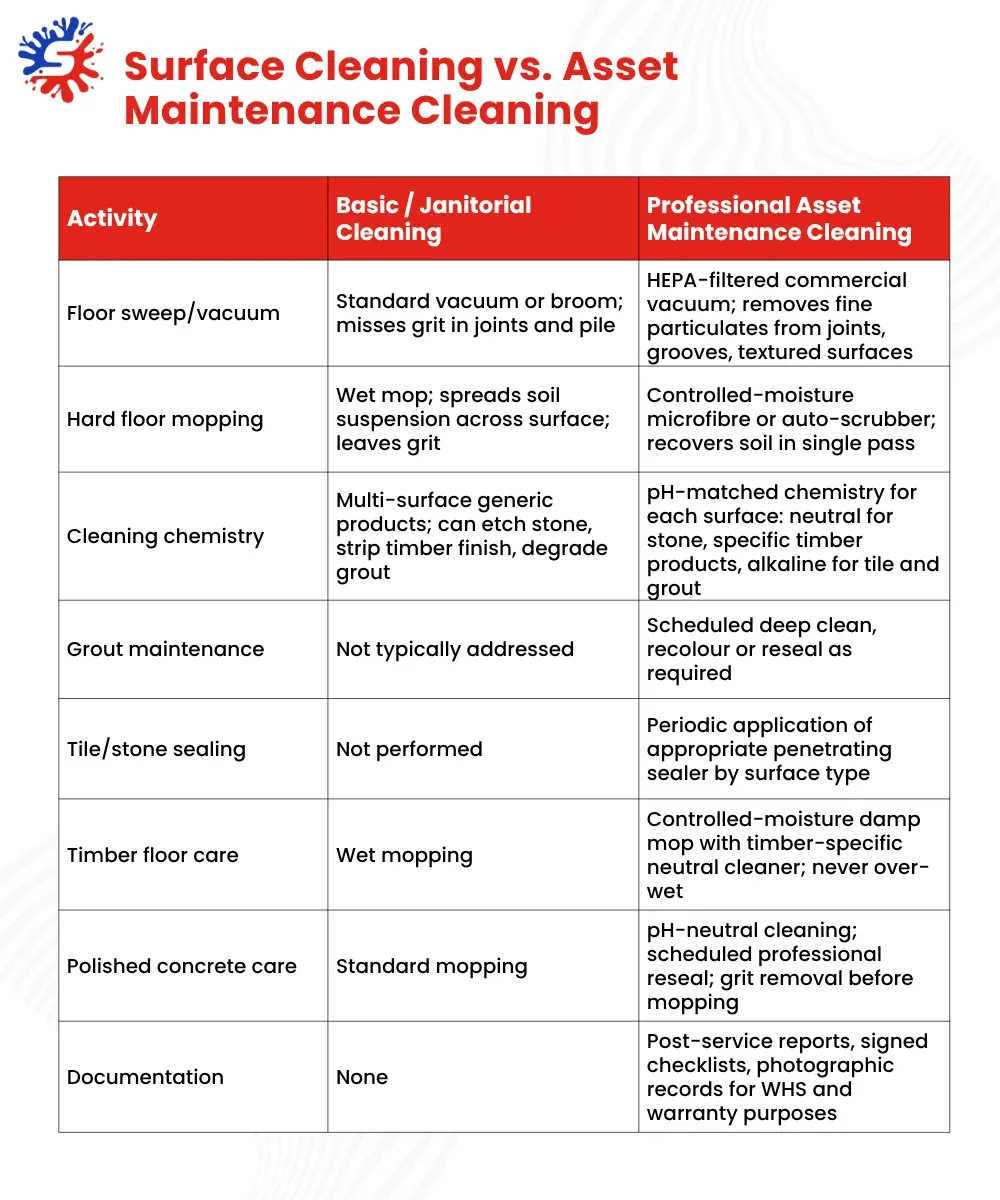
Our office cleaning services in Sydney include material assessment and floor-type-specific protocols as part of our standard commercial offering.
Scheduling That Does Not Disrupt Darlinghurst Operations
Darlinghurst operates across extended trading hours and multiple business types simultaneously. A structured cleaning programme accommodates this through:
-
After-hours cleaning for professional offices; standard schedule 6 PM to midnight
-
Early morning starts for medical and healthcare practices, clean premises before patient hours
-
Weekend deep cleans for high-traffic retail and hospitality, floor maintenance when premises are closed
-
Daytime maintenance cleaning during low-traffic windows, entry zones and amenities during quieter periods
-
Staged deep cleans for large premises, section-by-section to maintain operational continuity
Why Darlinghurst's Commercial Mix Demands Higher Cleaning Standards
Not every Sydney suburb has the same flooring maintenance requirements. Darlinghurst's specific commercial character creates conditions that accelerate floor degradation compared to lower-density or lower-traffic locations.
|
Darlinghurst Commercial Factor |
Floor Degradation Impact |
Specific Maintenance Response |
|
High pedestrian density from Oxford Street and surrounding entertainment precinct |
Significantly elevated grit, moisture, and pollutant load tracked into all ground-floor premises |
Daily entry zone sweep and mop; more frequent machine cleaning cycles |
|
Heritage building stock with original marble, stone, and hardwood floors |
Premium, irreplaceable materials with high sensitivity to incorrect cleaning chemistry |
Material specialist assessment; stone-safe chemistry only; documented maintenance protocol |
|
Medical and healthcare cluster (GP clinics, dental practices, allied health) |
Clinical hygiene obligations add pathogen control requirements to aesthetic floor maintenance |
Hospital-grade disinfection integrated into floor cleaning; wet area tile and grout protocols |
|
High-end retail and hospitality businesses |
Client-facing premises require consistently premium floor presentation at all times |
High-frequency maintenance, quick-response spot treatment, polishing schedules |
|
Boutique professional offices (legal, finance, consulting) |
Client meetings require presentation-ready premises at short notice |
Flexible scheduling, same-day capability, high standard finish requirements |
|
Mixed-use strata buildings |
Shared entry zones and common areas accumulate soil from multiple tenant types |
Strata-compliant cleaning schedules, entry zone priority protocols |
For businesses in Darlinghurst's with specific compliance requirements, see how we structure hygiene programmes in our commercial cleaning services overview.
Conclusion
Your commercial flooring is a significant capital asset, and in Darlinghurst’s high-traffic environment. By transitioning from basic janitorial services to a proactive, material-specific maintenance programme, you protect your surfaces from the cumulative damage caused by grit, moisture, and improper chemistry.
Don't let neglect erode the value of your workspace; partner with Spar Clean Australia to ensure your floors receive the technical care they deserve. Contact us today or visit our website to book your on-site assessment and stop paying for avoidable repairs.
Frequently Asked Questions
Find quick answers to booking, payments, pet-friendly policies, deep cleaning, and more. Our team is dedicated to making the process effortless and transparent. If you have additional questions, we're here to help ensure a seamless experience.
Get In Touch